Service Dog Tasks and the Public Access Test, Explained
This page explains the law in general terms. It is not legal advice. For a specific situation, contact the agency listed on this site or an attorney.
Two ideas come up again and again when people plan to train a service dog in Oregon: the tasks the dog performs, and the public access test. They are related, but they are not the same thing. Tasks are what make a dog a service dog under the law. The public access test is a training benchmark that shows whether a dog is ready to work calmly in public.
This guide walks through both as a series of steps. You will learn what counts as a task, how to choose and teach one, and how to use a public access test to check your progress. It also covers what Oregon and federal law say, so you know which parts are legal requirements and which are good practice.
The Short Version
- The ADA defines a service animal as a dog that has been individually trained to do work or perform tasks for an individual with a disability (ADA.gov, Service Animals FAQs).
- The work or task must relate directly to the person's disability.
- Comfort alone is not a task. Emotional support, therapy and comfort animals are not service animals under the ADA.
- The public access test is a training benchmark from the Assistance Dogs International (ADI) world. The ADA does not require a dog to pass it.
- The ADA has no official registry or required certification for service dogs.
Part 1: Understanding Service Dog Tasks
What counts as a task under the ADA
ADA.gov explains that a service dog does work or performs tasks directly related to the handler's disability. The dog does something, on cue or in response to a sign, that helps with a limitation caused by the disability. The task is trained. It is not just something the dog does naturally.
Oregon uses a similar idea. ORS 659A.143 and the implementing rule OAR 839-006-0345 describe an assistance animal as an animal individually trained to do work or perform tasks for the benefit of an individual. The Oregon definition is not limited by type of disability.
Examples of tasks by disability
ADA.gov gives examples of the kinds of work service dogs do. These are examples, not a complete list. Any trained task that is directly tied to a disability can qualify.
| Type of disability | Example tasks |
|---|---|
| Vision loss | Guiding the handler around obstacles |
| Hearing loss | Alerting the handler to sounds such as a knock, an alarm or a name being called |
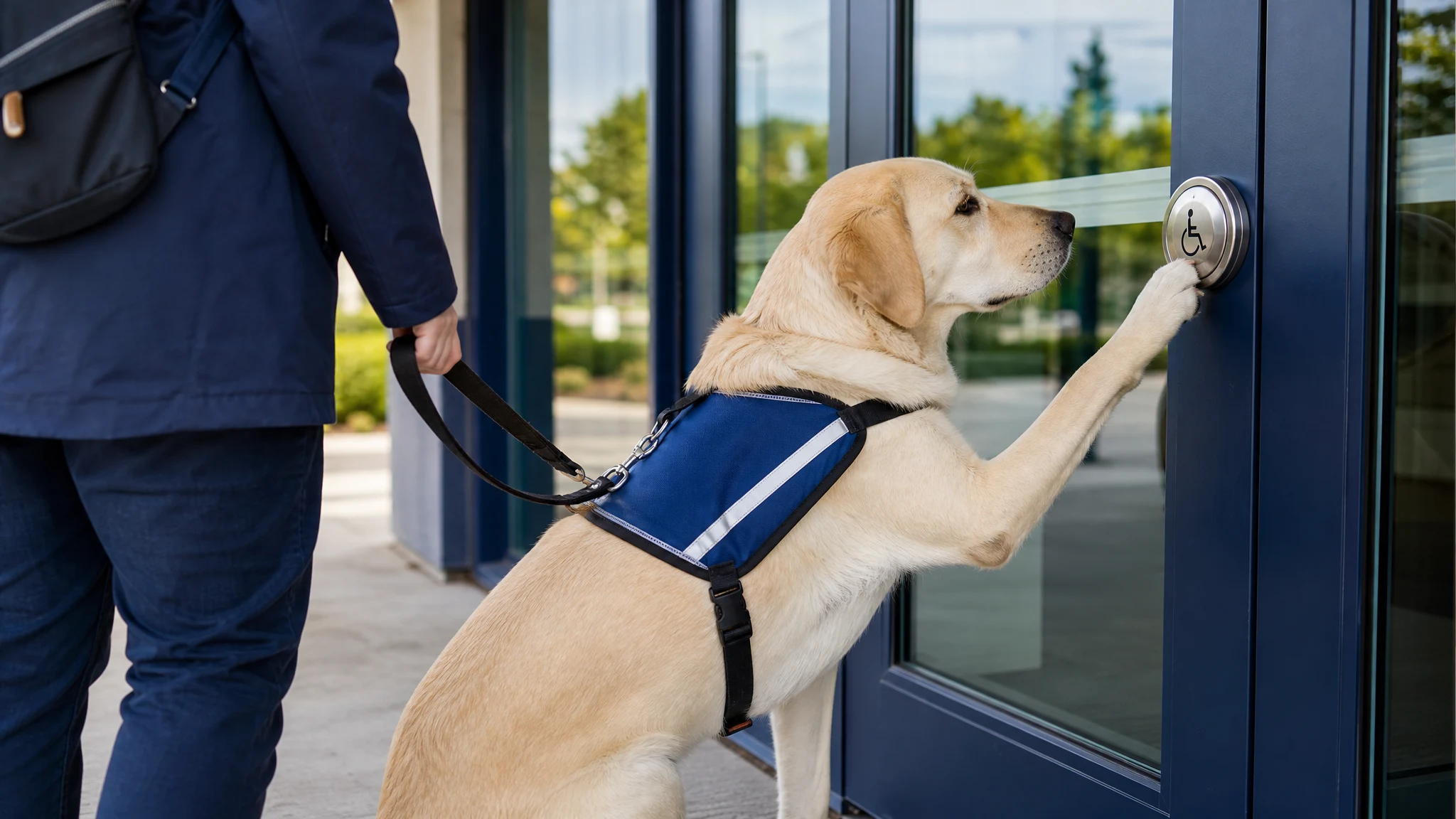
| Mobility disability | Retrieving dropped items, opening doors, or pulling a manual wheelchair |
| Seizure disorders | Responding during a seizure, such as getting help or staying with the person |
| Psychiatric disability, including PTSD | Interrupting repetitive behaviors, creating space in a crowd, or turning on lights in a room |
| Conditions needing medication | Reminding the handler to take medication |
So when people ask what tasks a service dog can do, the honest answer is that the range is wide. What matters is the link between the task and the disability, not the task's name.
Why comfort alone is not a task
A dog that calms you by being near you is doing something kind, but under the ADA that presence is not a trained task. The same goes for emotional support, therapy and comfort animals. They are not service animals under the ADA.
The line is exact. A dog that is trained to recognize the early signs of an anxiety episode and then performs a specific, trained action is doing work. A dog that simply makes its owner feel better is providing comfort. Both matter to people, but only the first is a service dog task.
Oregon programs reflect this too. For an overview of how a service dog differs from a therapy dog or an emotional support dog, the Oregon Humane Society publishes a plain-language comparison.
Part 2: Teaching a Task, Step by Step
Materials you will need
- A flat buckle collar or a well-fitted harness. Use only gear that is humane and comfortable.
- A standard leash.
- Small, soft treats your dog loves, plus a treat pouch.
- A clicker or a consistent marker word such as "yes."
- A notebook or phone to log each training session.
- Items related to the task, such as a dropped-item set, a door pull or a sound source.
- A quiet space to start, and later a range of public places.
Step 1: Name the disability-related need
Start with the problem, not the trick. Write down exactly what the disability makes hard and what a dog could do to reduce that difficulty. The task should answer that need. If you cannot connect the behavior to a disability-related need, it is probably not a task in the ADA sense.
Step 2: Break the task into small pieces
Every task is a chain of simple behaviors. Retrieving a dropped item, for example, can be split into noticing the item, picking it up, bringing it back and releasing it into your hand. Teach one piece at a time.
Step 3: Use reward-based teaching
Mark the exact moment your dog does the right thing, then reward it. This matches the approach recommended by the American Veterinary Society of Animal Behavior (AVSAB), which favors reward-based training. Do not use shock, prong or choke collars, and do not use dominance methods. They can create fear and stress, which works against a dog that has to stay calm in public.
Step 4: Add a cue or a trigger
Some tasks are done on a cue, like a word or hand signal. Others are done in response to something, like a sound or a change in the handler. Add the cue only after your dog reliably offers the behavior. Then practice with the trigger in realistic settings.
Step 5: Practice across places and distractions
A task that works in your living room may fall apart in a busy store. Move slowly through new rooms, new floors and new levels of noise. Lower your expectations when you change the setting, and raise them again as your dog succeeds.
Step 6: Keep a training log
Write down what you worked on, where, and how it went. A log helps you see patterns. It also helps you answer the question staff are allowed to ask: what work or task has the dog been trained to perform?
Part 3: The Public Access Test
What it is, and what it is not
A service dog public access test is a way to check whether a dog behaves safely and politely in public places. Many assistance dog programs use one. Assistance Dogs International, the group that accredits many programs, is the best-known source for this kind of standard. Check ADI directly for the current version of its test and its scoring, since the details can change.
This part matters: the public access test is a training benchmark. The ADA does not require a service dog to pass it, and the ADA does not require any certification. ADA.gov says staff may not demand special ID or paperwork, and there is no official registry. Never treat an online registration or certificate as legal proof of anything.
Why take one, then? Because the law does allow a business to ask a dog to leave if it is out of control or not housebroken. A test gives you an honest check on those exact risks before you take your dog into the world.
What a typical public access test looks at
Specific test items vary by program, so treat this as a general picture and not as the official ADI checklist. Tests of this kind usually look at skills like these:
- Walking politely on a loose leash through a crowd.
- Staying calm around other people, dogs and sudden noises.
- Ignoring dropped food and other temptations.
- Settling quietly under a table or chair.
- Staying controlled at doorways, elevators and on stairs.
- Not barking, lunging or soliciting attention from strangers.
- Staying clean and relieving itself only when and where the handler asks.
How to use a public access test, step by step
- Get the written standard. Ask your training program or trainer which test they use, or look up ADI's published standard.
- Score yourself honestly. Walk through each item at home first, then in quiet public places.
- Practice the weak spots. If your dog sniffs shelves, work on that in short, rewarding sessions.
- Test in real places. Try stores, medical office lobbies, public transit and outdoor areas in your part of Oregon. Always follow each place's rules about timing and access.
- Have a neutral person watch. A trainer or friend sees things you miss when you are focused on the dog.
- Retest regularly. Behavior can slip with age, illness or changes in routine. A yearly check is a sensible habit, not a legal rule.
- Retire or pause when needed. If your dog shows lasting stress or fear in public, the kind choice is to rest or retire the dog from public work.
Part 4: How Oregon Law Treats Access
Under ORS 659A.143, as summarized from the Oregon Legislature's ORS Chapter 659A, places of public accommodation and state government services have these rules:
- They may not ask about the nature or extent of a person's disability.
- They may not require documentation proving an animal is an assistance animal.
- They may not charge a fee or admission charge for the animal.
- They may ask whether the animal is required because of a disability, and what work or task it is trained to do.
- The handler must keep control, usually with a harness, leash or tether, or by voice or signal if a tether would interfere with the animal's work.
- An animal may be removed if it is not housebroken, or if it is out of control and the handler does not take effective action. The place must then give the person a reasonable chance to get goods and services without the animal.
- A place that customarily charges for damage may charge for damage the animal causes.
- The place does not have to provide care or supervision for the animal.
The federal ADA allows the same two questions: is the dog a service animal required because of a disability, and what work or task has the dog been trained to perform (ADA.gov, Service Animals FAQs).
Oregon law also covers dogs in training. ORS 659A.143 defines an assistance animal trainee and a trainer, and the trainer has the same no-fee and access provisions as a person with a disability. The trainer must still keep control of the animal. If you are not sure how this applies to your situation, check with the Oregon Bureau of Labor and Industries (BOLI).
For a wider look at programs, costs and Oregon rules, see our guide to service dog training in Oregon: laws, programs and costs.
Tips and Common Mistakes
Tips
- Keep sessions short and end on a success.
- Train when your dog is rested, not worn out.
- Reward calm behavior in public often, especially early on.
- Be ready to say, in plain words, what your dog is trained to do. Practice the answer so it feels easy.
- Look at your dog's body language. Lip licking, yawning and a stiff posture can signal stress.
Common mistakes
- Counting comfort as a task. Being calming or cuddly is not a trained task under the ADA.
- Buying a vest, ID card or certificate and calling it done. These are not required, and they do not prove anything. Sellers of online registrations are not part of any official system.
- Skipping the public step. A dog that performs perfectly at home may struggle in a crowd.
- Treating the public access test as a legal pass-fail. It is a tool for you and your trainer.
- Using harsh methods. Corrections and force can damage trust and make behavior less reliable.
- Rushing. Many dogs need months or more to build reliable skills, and not every dog is suited to service work.
What to Expect
Results vary with the dog, the handler and the task. With steady, reward-based practice, many dogs can learn to perform trained tasks more reliably and to stay calmer in public. Progress is rarely a straight line, and some dogs may not be suited to this work. Working with an experienced trainer or an accredited program may help you spot problems early.
If you are looking for a program rather than training a dog yourself, Oregon has several. The ADI member list for Oregon includes organizations such as Paws Assisting Veterans in Cornelius, Joys of Living Assistance Dogs in Salem, Dogs for Better Lives in Central Point and Bergin University of Canine Studies in Canyonville. Costs and wait times differ, so contact each program directly for current details.
If Access Is Denied
If you believe a business or state service wrongly denied access to a person with a service dog, the Oregon Bureau of Labor and Industries (BOLI) Civil Rights Division takes complaints. BOLI lists an online complaint form, phone 971-245-3844 and email [email protected]. Ask BOLI about filing deadlines, since time limits may apply. This article explains the law in general terms and is not legal advice.
Sources
- ADA.gov, Service Animals FAQs
- Oregon Legislature, ORS Chapter 659A (ORS 659A.143)
- OAR 839-006-0345, Oregon Administrative Rules
- Oregon Bureau of Labor and Industries, Civil Rights Division
- Assistance Dogs International, Oregon member search
- Oregon Humane Society, Service dog, therapy dog, emotional support dog: what's the difference