Service Dogs in Training in Oregon: Do They Have Public Access?
This page explains the law in general terms. It is not legal advice. For a specific situation, contact the agency listed on this site or an attorney.
Yes, in Oregon they can. The federal Americans with Disabilities Act (ADA) does not cover dogs in training, but Oregon's own statute does. This guide explains how to use that protection correctly, step by step, so a training outing goes smoothly for you, the dog and the staff you meet.
It covers who qualifies, what a business may and may not ask, and what to do if you are turned away. It is a plain-English summary of the law, not legal advice.
The short answer on service dog in training rights
ADA.gov says the ADA defines a service animal as a dog that has been individually trained to do work or perform tasks for an individual with a disability. A dog still in training has not finished that individual training. For that reason, the ADA is not what protects a trainee's access.
Oregon fills that gap. The Oregon Legislature's ORS Chapter 659A, in ORS 659A.143, defines an assistance animal trainee as an animal undergoing a course of development and training to do work or perform tasks for an individual. It also defines an assistance animal trainer as an individual exercising care, custody and control over the trainee.
The trainer is covered by the same no-fee, access and control provisions that apply to a person with a disability. That is the core of Oregon service dog in training laws.
Who is covered
The statute text, as repeated in Oregon Administrative Rule 839-006-0345, is not limited to professional trainers. It describes the trainer as the individual who has care, custody and control of the trainee. It does not say the person must be employed by a program or hold a credential.
The same text states no age condition, no harness condition and no ID condition for trainees. The one requirement it stresses is that the handler or trainer must maintain control of the animal.
Two limits are worth knowing:
- The statute covers an animal being trained to do work or perform tasks. A pet that is simply well behaved is not a trainee under this definition.
- Oregon's definition of an assistance animal refers to a dog or other animal designated by administrative rule. Check the current rule text, or ask the Bureau of Labor and Industries (BOLI), if your animal is not a dog.
Where the access applies
ORS 659A.143 applies to places of public accommodation and state government services. In everyday terms, that means the kinds of places open to the public, such as stores, restaurants and public offices that offer services.
This guide does not say how trainee access works in housing or at work. The sources reviewed for this page did not settle that question for trainees. Contact BOLI before you assume a trainee has the same rights in those settings.
Materials you need
You do not need to buy any special paperwork. These items are useful:
- A well-fitting harness, leash or other tether suited to the dog. Oregon does not require a harness for trainees, but control is required, and a tether is the usual way to show it.
- Reward-based training tools: small treats, a treat pouch and a mat or settle blanket.
- Waste bags and a cleanup kit.
- Water and a collapsible bowl for the dog.
- A short, calm way to say what you are doing, for example: "This is a service dog in training. I am handling it."
- BOLI's contact details, saved on your phone in case you need them.
A vest or ID tag is optional. Oregon law, as summarized above, sets no vest or ID requirement for trainees. Do not buy a "registration" or "certification" online. Neither the ADA nor the Oregon provisions described here require one, and a purchased certificate is not legal proof of anything.
Step-by-step: taking a dog in training out in public
Step 1. Confirm that you are the trainer in the legal sense
Under ORS 659A.143, the protection goes to the individual exercising care, custody and control over a trainee. Ask yourself whether the dog is actually in a course of development to do work or perform tasks, and whether you are the person handling it.
If you are training your own dog for your own disability, or helping a program train a dog, you can fit this description. If you are just taking a pet along for the company, you do not.
Step 2. Make sure the dog is ready for the setting
Access rights do not replace readiness. Under the Oregon summary, a place may remove an animal that is not housebroken, or that is out of control when the handler does not take effective action.
Start in quiet, low-demand settings and build up. A short visit that ends on a good note teaches more than a long one that falls apart.
Step 3. Keep the dog under control
Use a harness, leash or tether. The Oregon provisions allow control by voice or signal only where a tether would interfere with the work the animal does. A trainee that is still learning a task is usually safest on a leash.
Keep the dog close, out of aisles and away from other customers' food and belongings. Reward calm behavior often.
Step 4. Expect two questions, and answer them briefly
When it is not obvious that a dog is a service animal, ADA.gov says staff may ask two things: is the dog required because of a disability, and what work or task has the dog been trained to perform?
Oregon's summary is similar. A place may ask whether the animal is required because of a disability and what work or task it is trained to do. It may not ask about the nature or extent of a disability, and it may not require documentation proving the animal is an assistance animal.
For a trainee, a short truthful answer works best. For example: "I am training the dog to retrieve dropped items and to alert to a change in my condition." Keep it to the task. You do not have to explain your diagnosis.
Step 5. Do not accept a fee for the dog
Under ORS 659A.143, as summarized, a place of public accommodation or state government service may not charge a fee or admission charge for the animal. That protection extends to the trainer.
A place that customarily charges for damage may charge for damage the animal causes. It does not have to provide care or supervision for the animal, so you are responsible for the dog at all times.
Step 6. If a dog is removed, stay calm and ask about alternatives
If staff remove the dog because it is out of control or not housebroken, the place must give the person a reasonable chance to obtain goods and services without the animal. Take the dog out, regroup, and ask what options exist.
Arguing at the counter rarely helps either party. Take notes later.
Step 7. Document a denial and know where to complain
If you believe a place wrongly refused you, write down the date, time, place, the names or descriptions of the staff and exactly what was said. Then contact the Oregon Bureau of Labor and Industries, Civil Rights Division, which is the complaint agency for these laws.
- Online complaint form: complaints.boli.oregon.gov
- Phone: 971-245-3844
- Email: [email protected]
- Mail or in person: 1800 SW 1st Ave, Suite 500, Portland, OR 97201
Ask BOLI how long you have to file. This guide does not state a filing deadline, because it could not be confirmed from an official source.
Tips for smoother outings
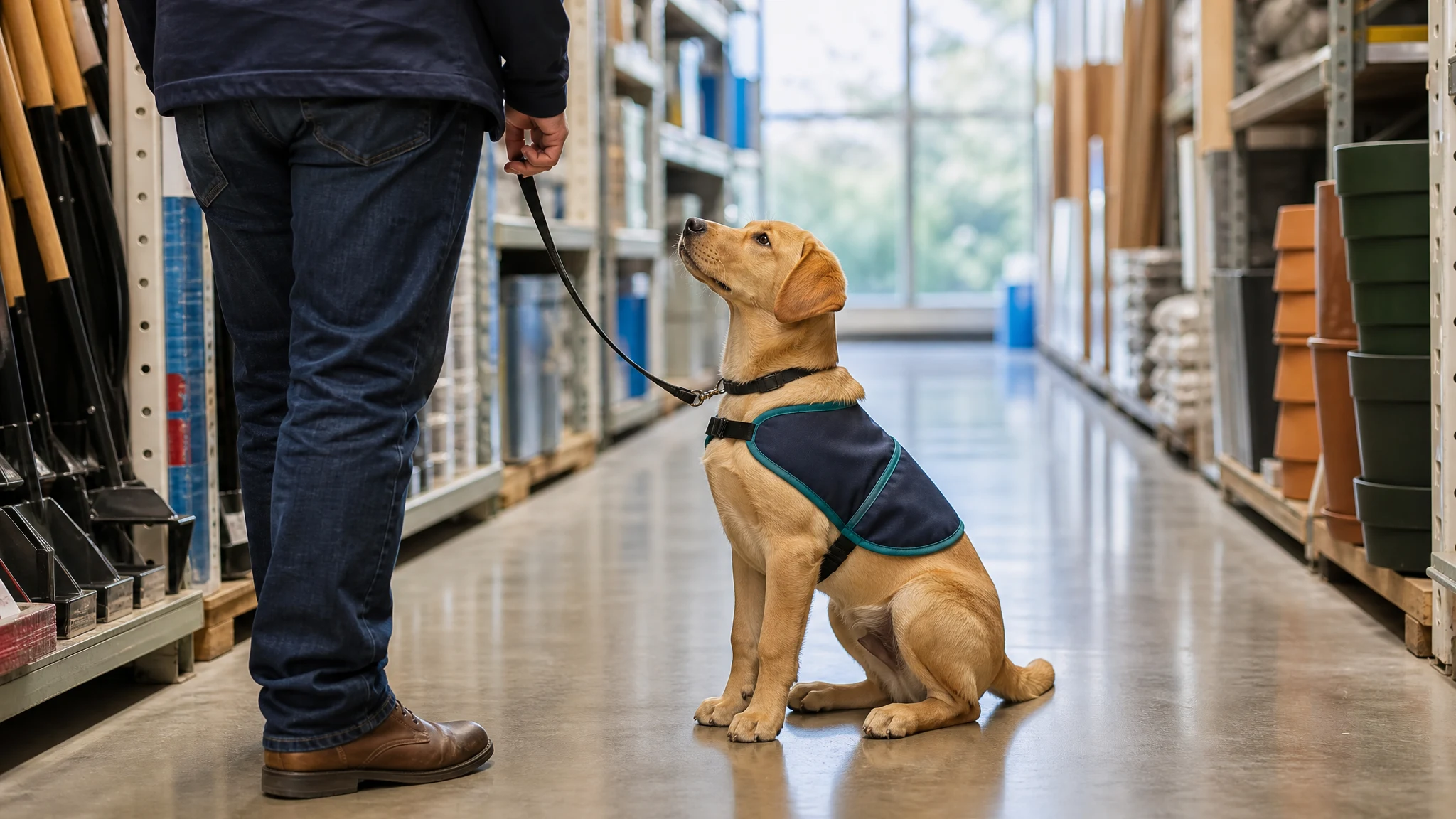
- Plan short trips. Ten calm minutes in a hardware store beat an hour of stress.
- Use reward-based methods only. The American Veterinary Society of Animal Behavior (AVSAB) supports humane, reward-based training. Avoid shock, prong or choke collars, alpha rolls, scruffing and dominance methods. They can raise fear and make public work harder.
- Choose your timing. Quiet hours let you practice with fewer distractions.
- Bring a plan for a break. A car, a quiet corner outdoors or a short walk gives the dog a reset.
- Be courteous. A friendly tone makes staff more willing to work with you if a problem comes up.
- Look into accredited programs. If you are working with a program, ask it how it prepares dogs and handlers for public outings.
Common mistakes to avoid
- Treating a vest as a pass. A vest does not create legal rights. Behavior and control matter far more.
- Buying a registry certificate. No official service dog registry exists under the ADA, and the provisions described here do not require one.
- Bringing a dog that is not ready. A dog that barks, lunges or toilets indoors can be removed, and a bad outing sets training back.
- Mixing up the categories. Emotional support, therapy and comfort animals are not service animals under the ADA. A dog that provides comfort by being present is different from a dog individually trained to do work or perform tasks.
- Over-explaining a disability. You are only asked about the need for the dog and the task. Share no more than you want to.
- Assuming rights elsewhere. Do not assume trainee access applies at an airport, in a rental home or at work. Check with the right agency first.
- Misrepresenting the dog. Do not claim a dog is a fully trained service dog when it is not. Say "in training." This guide does not state what penalty Oregon sets for misrepresentation, so check with BOLI or the Legislature's statutes if you have a concern.
Expected results
If you follow these steps, many handlers find that most visits to public places go without trouble. Staff who know the Oregon rule are more likely to be accommodating, and a calm, controlled dog tends to make that easy.
Results vary. Some staff are unfamiliar with the trainee provision, and some disputes may take time to sort out. A controlled, well-prepared dog generally helps, but it does not remove the chance of a disagreement.
What if a place says no, or you are outside Oregon?
If a business says it does not allow dogs in training, you can politely point out that Oregon's ORS 659A.143 covers trainees. If the answer is still no, you can leave and file a complaint with BOLI as described above.
Other states have their own rules, and some give dogs in training no public access at all. Where a state grants no such right, a business is free to say no. In that case you ask permission and choose pet-friendly places. Check the law of any state before you travel.
Housing, work and travel
These are separate areas of law, and the answers differ from public access.
Disability Rights Oregon states that housing providers cannot charge a pet deposit or fee for a service animal. It also says allowing a service animal in the workplace is a form of reasonable accommodation, and that an employer may require documentation that the animal is fully trained and can work in the environment. Disability Rights Oregon is a secondary source, and its points are about service animals rather than trainees.
ORS 659A.145 prohibits refusing reasonable accommodations in housing because of disability. For a dog still in training, ask BOLI how these rules apply to your situation. For air travel, check with the U.S. Department of Transportation. This page does not cover it.